

For many Shopify merchants, accounting is a topic they prefer to address as late as possible – often only when their tax advisor first requests a DATEV export or when the tax authorities demand clarification. However, especially in the German market, a reliable, automated accounting integration is not just an organizational convenience, but an absolute necessity.
This is because Shopify itself is a global system and does not automatically map many German specificities: from GoBD-compliant invoicing to correct tax rates, payment reconciliation, and the remittance of VAT within the EU. Therefore, specialized tools come into play that close precisely this gap.
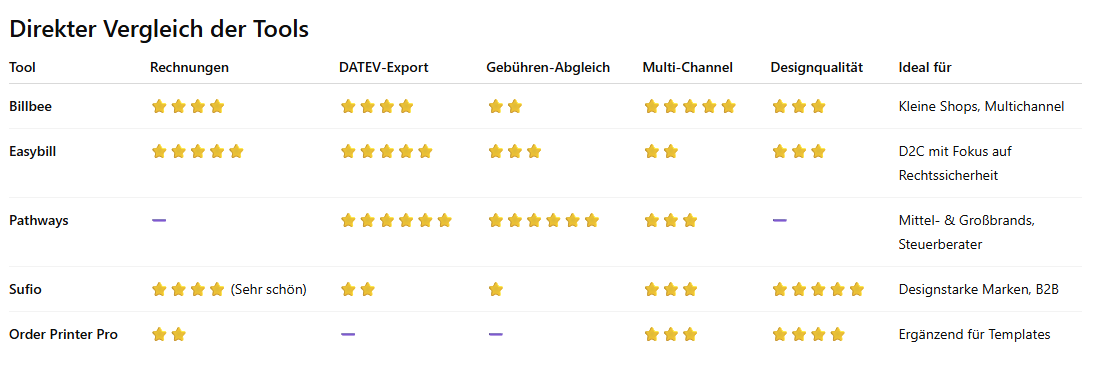
In this article, we compare five of the most important solutions on the market: Billbee, Easybill, Pathways, Sufio, and Order Printer Pro. Each of them has a different focus, and which tool is right depends heavily on the size of the store and the accounting requirements.
Why accounting with Shopify is more complex than you think
Shopify is one of the most modern and flexible shop systems, but from an accounting perspective, there are limitations. The tax logic is designed internationally, and German specificities such as the small business regulation, differentiated tax rates, reverse charge, or GoBD-compliant number ranges are not natively integrated.
In addition, while Shopify stores orders and payment statuses, it hardly processes any accounting-relevant information. Fees from Shopify Payments, PayPal, or Klarna are not automatically assigned to the correct accounts. Credit notes, cancellations, and returns are visible in the store, but not in a format that directly suits DATEV.
This means that all professional Shopify merchants need one or more tools that create invoices, correctly book payments, and output the data in a way that the tax advisor can process them – ideally fully automatically.
Billbee – the all-rounder for multi-channel and SMEs
Billbee is particularly popular with smaller and medium-sized merchants because it is much more than just invoicing software. Billbee connects Shopify with marketplaces like Amazon, Etsy, or eBay and allows all orders from different channels to be managed centrally.
Invoicing works reliably and is GoBD-compliant, DATEV exports are possible and solid, and above all, the automation functions are convincing. Merchants can define rules that control almost every process in the background: from sending invoices to inventory updates and shipping notifications.
The downside is that Billbee seems a bit more complex to set up and has a certain learning curve. Furthermore, the system eventually reaches its natural limits with very large data volumes and rapidly growing D2C brands. For multi-channel merchants and shops with manageable turnovers, Billbee nevertheless remains one of the most flexible overall solutions on the market.
Easybill – the reliable solution for legally compliant invoices and clean DATEV data
Easybill is considered one of the most stable solutions for German invoicing at all. Many Shopify merchants appreciate the clarity of the interface, the high reliability, and the fact that Easybill has specialized in legally compliant documents for years.
With Easybill, invoices can be automatically generated, sent, and also corrected retrospectively. The DATEV export functions are among the best on the market, which tax advisors particularly appreciate. More complex tax scenarios such as intra-community supplies, reverse charge cases, or mixed tax rates can also be mapped, but sometimes require manual fine-tuning.
Easybill is the perfect solution for merchants who primarily sell via Shopify and need clean, legally compliant, and scalable accounting. However, those who connect many marketplaces will reach their limits faster, as Easybill offers fewer multi-channel options than Billbee.
Pathways – the professional DATEV and tax advisor solution for larger D2C brands
Pathways is by far the deepest solution in this comparison when it comes to DATEV integration and payment reconciliation. While other tools focus on generating invoices or creating exports, Pathways goes a step further: it processes payment flows from Shopify Payments, PayPal, or Klarna fully automatically – including fees, payouts, partial refunds, and disputes.
The result is accounting data that arrives at the tax advisor almost perfectly prepared. Pathways particularly demonstrates its strengths in EU-wide trade, as complex tax logics, OSS reports, or different tax rates are cleanly mapped here.
In combination with Easybill or Sufio, many medium-sized and large D2C brands use Pathways as the standard solution for precise accounting and reporting.
Sufio – Premium invoice design with a focus on automation and B2B
Sufio is one of the most popular invoicing tools in the Shopify App Store – not because it is so deep from an accounting perspective, but because the invoices simply look excellent. The app strongly focuses on design, internationality, and automation. Many fashion, beauty, and lifestyle brands use Sufio because the tool perfectly suits modern D2C brands.
Sufio particularly excels in the B2B sector: reverse charge procedures, intra-community supplies, or VAT ID validations are implemented elegantly and without much configuration. The automation is designed so that the merchant has no manual effort.
However, Sufio is less strong in DATEV export or in preparing data for the tax advisor. This is precisely why Sufio is often used in combination with Pathways: beautiful invoices on the front, perfect files on the back.
Order Printer Pro – the flexible solution for document templates, but not real accounting
Order Printer Pro is not an accounting tool, but a document generator. The app can be used to create, print, or email invoices, delivery notes, return receipts, and other documents. The templates are flexibly customizable, which particularly suits merchants who want to generate invoices internally within Shopify but need more design options.
However, Order Printer Pro lacks any kind of deep tax logic, DATEV export, or accounting intelligence.
Furthermore, Order Printer Pro alone is not compliant with tax authorities, as invoices can always be edited arbitrarily. The tax authorities do not like that at all!
Which solution is right for which Shopify store?
The choice depends heavily on the business model and the size of the store.
Smaller shops with a single sales channel will find a stable, legally compliant solution in Easybill, while multi-channel merchants will enjoy more flexibility with Billbee.
Design-oriented brands will benefit from Sufio, while larger merchants with a strong focus on correct accounting and tax advisor compatibility can hardly bypass Pathways.
Order Printer Pro remains a useful supplementary tool but does not replace accounting software.
Many professional merchants therefore use a combination: for example, Easybill + Pathways for maximum accuracy, or Sufio + Pathways if design plays a particularly important role.
Conclusion: The right accounting connection is a decisive success factor
Reliable, automated accounting is the basis for clean finances, fewer errors, and significantly less manual effort. With the right tools, this process can be fully automated – from invoicing to payment reconciliation.
As an agency, we support Shopify merchants in selecting the ideal combination of tools and setting them up completely. This includes tax logics, automations, DATEV interfaces, payment reconciliations, and collaboration with the tax advisor.